How to Verify a Moving Company: USDOT Number, FMCSA Lookup & Reviews
Quick answer: To check that a moving company is legitimate, verify it in six steps: (1) find its USDOT and MC numbers, (2) search them in FMCSA's mover database, (3) ask whether it is a carrier or a broker, (4) get valuation and insurance details in writing, (5) read recent reviews and complaint records, (6) get a written estimate before signing.
Key takeaways
- Interstate movers and brokers must have a USDOT number. FMCSA's database shows registration, authority, insurance and complaints.
- Registered is not the same as authorized: a company may be registered but not authorized to move household goods.
- Ask who will do the work, whose trucks they use and whether partners ever help. A legitimate company can explain.
- Never sign blank paperwork, and get estimate, deposit and payment terms in writing.
Here is each step in order, then what is different for moves around Washington, DC, and how to check MyProMovers the same way.
How do you verify a moving company? 6 steps
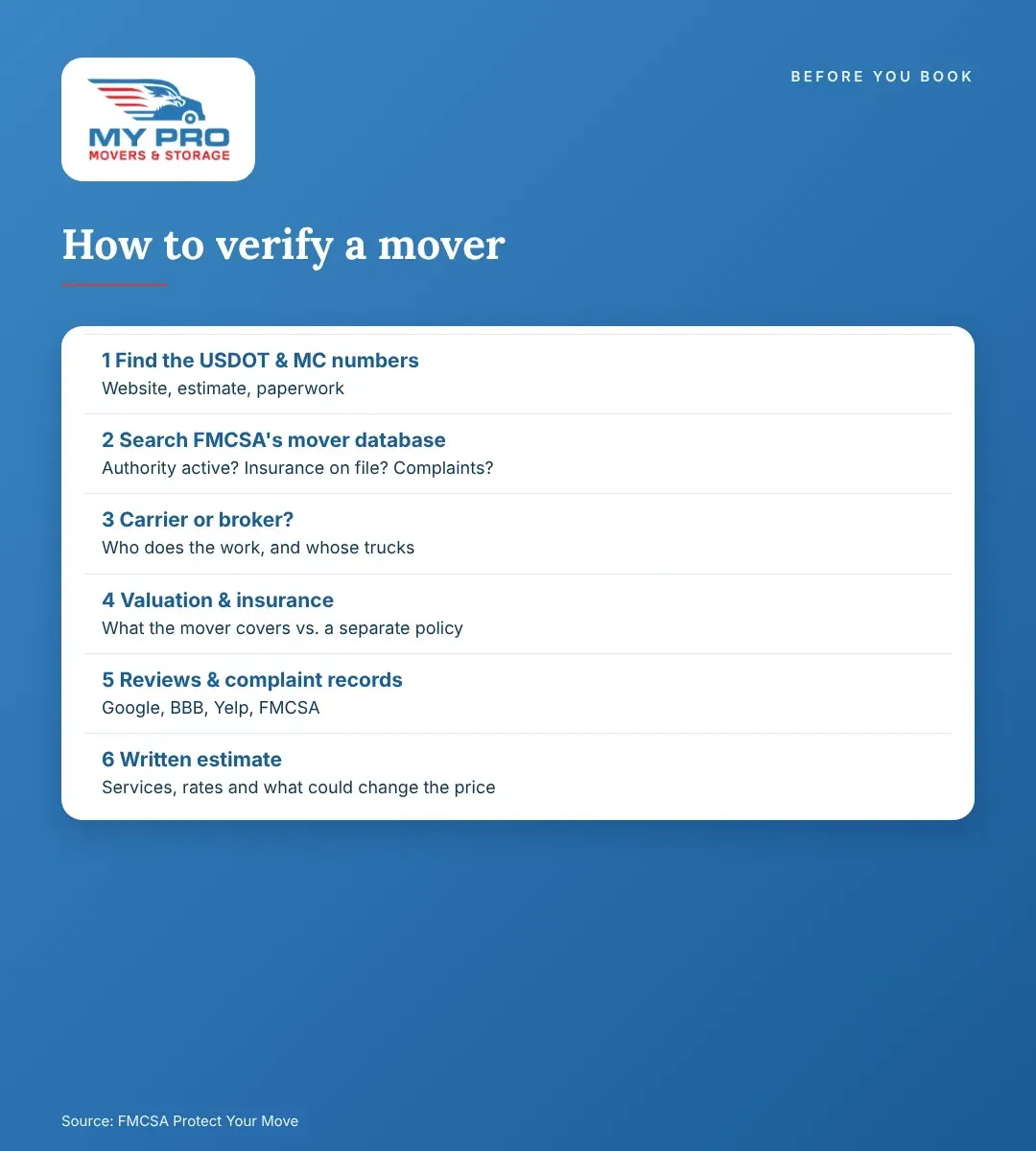
Use this table as your checklist. Each step is explained below.
| Step | What to check | Where | Be cautious if |
|---|---|---|---|
| 1. USDOT & MC numbers | Numbers are listed and match the company name | Website footer, estimate, truck door | No number, or a number for a different name |
| 2. FMCSA lookup | Active household goods authority; complaint history | FMCSA mover database | Authority inactive or missing, or the record does not match |
| 3. Carrier or broker | You can tell who does the work and whose trucks are used | FMCSA record, the estimate, a direct question | No clear answer about who will do the move |
| 4. Valuation & insurance | Valuation limits and any third-party insurance options in writing | Contract, estimate, certificate of insurance | "You're fully covered" with nothing in writing |
| 5. Reviews & complaints | Recent, detailed reviews; complaint history | Google, BBB, Yelp, FMCSA database | Only a few vague reviews, or complaints that went unanswered |
| 6. Written estimate | Estimate in writing that lists services, rates and what could change the price | Estimate document, contract | Price only by phone; blank or unsigned forms |
1. Find the USDOT and MC numbers
FMCSA says interstate movers and brokers must be registered with the federal government and have a USDOT number. Movers that operate interstate for hire usually also hold an MC (motor carrier) number, which refers to operating authority. A legitimate mover shows these numbers on its website and estimate. If a company will not give them, or says it does not need them for a move that crosses a state line, ask it to explain before you go further.
2. Look the company up in FMCSA's mover database
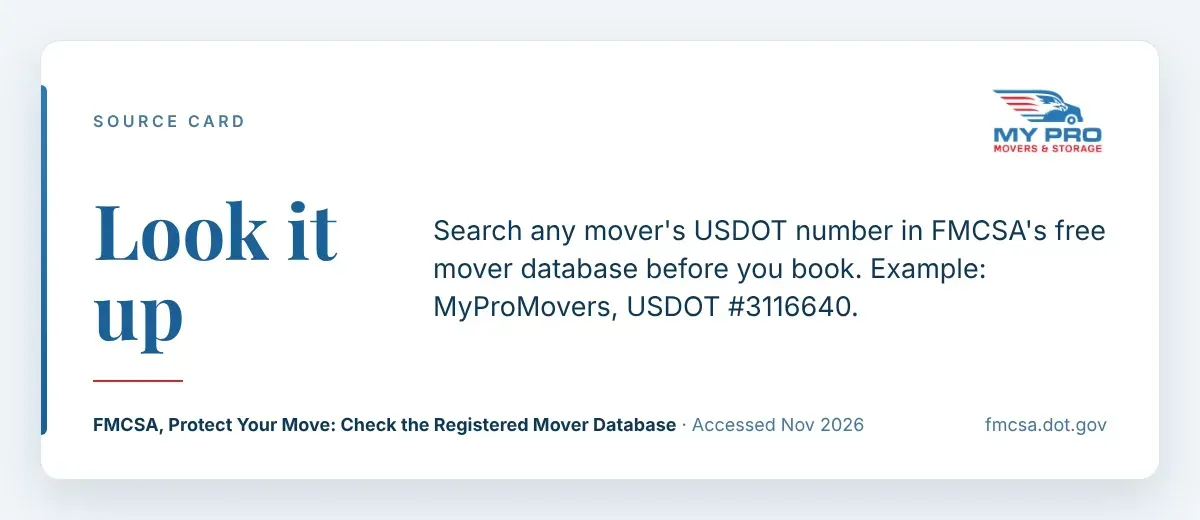
Go to FMCSA's registered mover database and search by USDOT number or company name. Check that the name and address match the company you are talking to, that its household goods authority is active, that insurance is on file and that the complaint history is reasonable for its size. FMCSA notes that a company may be registered but not authorized to move household goods, so check both. A large mover will have some complaints; a small company with many recent ones deserves questions.
3. Ask whether it is a carrier or a broker
FMCSA's consumer handbook defines a household goods broker as a company that "arranges for the transportation of your shipment but does not provide line-haul transportation." Brokers must be registered as brokers, and FMCSA's guidance says a broker acts as a middleman and is not authorized to transport goods.
Ask directly: "Who will do my move? Are the movers your employees? Do you use your own trucks? Do partners or subcontractors ever help?" Then compare the answer with the FMCSA record. Many reputable carriers occasionally rent a truck or bring in a partner for a specialty task, so a rental truck or a partner is not decisive by itself. What matters is that the company can tell you plainly who is responsible for your belongings.
4. Check valuation and insurance
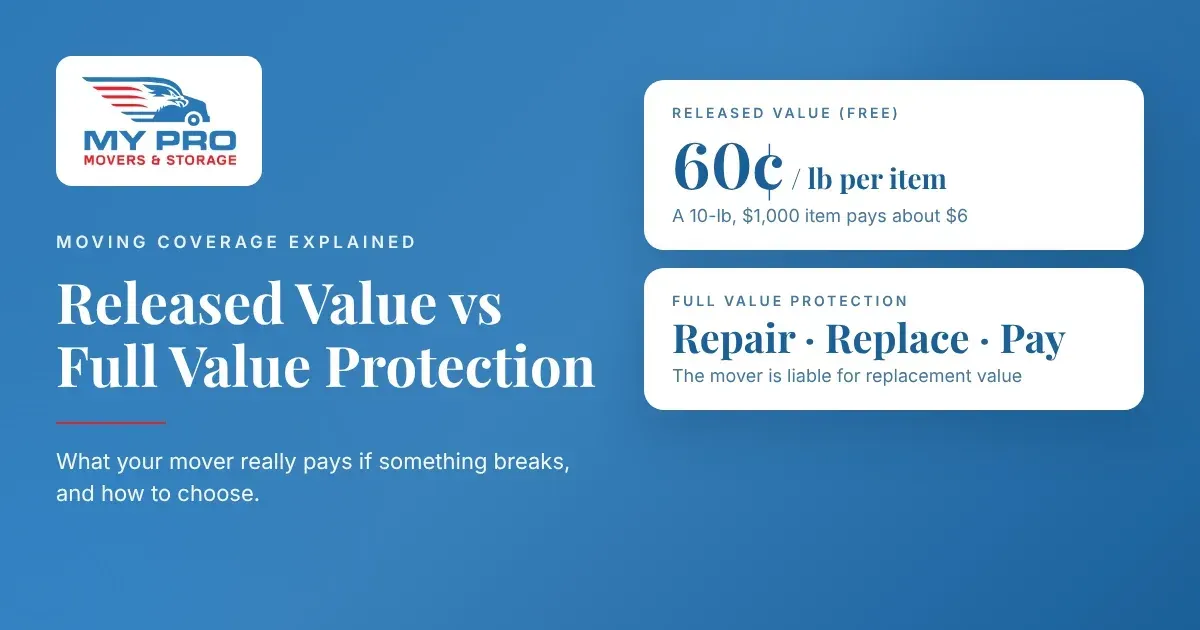
These are two different things. Valuation is the mover's responsibility for loss or damage, and it is set in your contract. For interstate moves, FMCSA's handbook says the basic released-value option covers "no more than 60 cents per pound, per article," so a 50-pound TV would be covered for about $30. Ask which valuation options the mover offers, what each costs and what the limits are.
Third-party moving insurance is a separate policy you buy from an insurer; it is your choice and best arranged early. Do not rely on a verbal "you're covered." Ask for the valuation terms and any insurance options in writing, and ask for a certificate of insurance if your building requires one.
5. Read reviews and complaint records
Look at the last 12 months on Google, BBB and Yelp. Read the 3- and 4-star reviews: they show what happens when something goes slightly wrong, and whether the owner replies and fixes it. Be cautious with a company that has only a few vague five-star reviews or a sudden burst of them, and compare reviews with its FMCSA complaint history. The questions to ask below help you test what you read.
6. Get the estimate in writing
For interstate moves, FMCSA's handbook says a verbal quote is not an official estimate and that the written estimate should be dated and signed. Ask whether the estimate is binding or non-binding, and what would change the price, such as added items or a changed scope. Local moves are often billed by the hour, so the estimate is a projection and the final charge follows actual time worked; ask for the hourly rate, minimum, travel or service charge and payment terms in writing.
Want to check a mover against every step?. Look up our USDOT number in FMCSA's database, then request a free written quote. Get my free moving quote
Does a local move in the DC area need a USDOT number?
Sometimes. FMCSA's consumer page says that as long as goods cross a state line and involve a mover at any point, it is an interstate move, and the truck does not have to physically cross the line. A move between DC, Maryland and Virginia can therefore fall under federal interstate rules even when it is short. Exceptions can apply, so ask the mover which rules cover your route and which registrations it holds.
A move that stays within one state follows that state's rules for household goods movers, and each state sets its own. In Virginia, for example, movers operating within the state hold a Virginia certificate. If you are unsure, ask the mover, or check with your state or local consumer affairs office.
Questions to ask before you hire
| Ask about | Why it matters | What a clear answer sounds like |
|---|---|---|
| A price without a written estimate | A verbal number is not an official estimate | A written estimate listing services, rates and what could change the price |
| USDOT number missing or not matching | You cannot confirm registration or authority | A number on the website and estimate that matches the FMCSA record for the same company name |
| Who does the work and whose trucks | A broker sells the move to a carrier; a carrier may also rent a truck or use a partner | Whether crews are employees, whose trucks are used, and whether and why a partner or rental truck is involved |
| A different truck or crew on moving day | It may be a rental truck or a partner, which is not automatically a problem | A call to the company you booked that confirms who is coming and why |
| A new charge or payment request | Some are legitimate: a service you requested, or payment timing already in your contract. The concern is a charge you were never told about | Where it appears in your contract or estimate. Do not agree to unexplained amounts, especially if goods are being held until you pay |
| Blank or incomplete paperwork | Terms can be filled in after you sign | Never sign a blank document; keep copies of everything |
What to do if something goes wrong
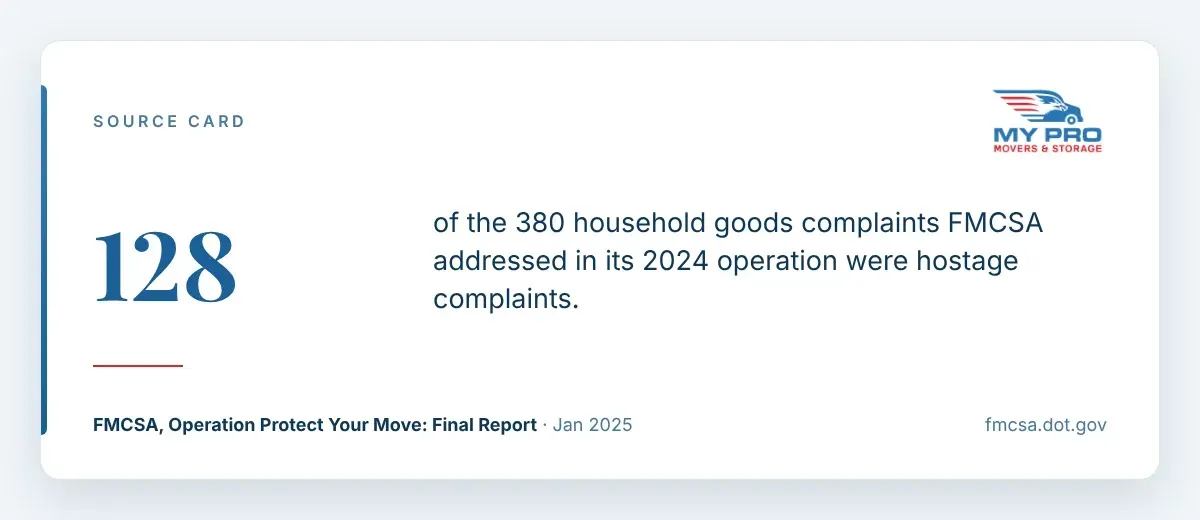
FMCSA's final report on its 2024 Operation Protect Your Move addressed 380 household goods complaints, 128 of them hostage complaints(a mover holding belongings until the customer pays more). These are national figures, not DMV-specific.
- Document everything. Photos of damaged items, the inventory, the estimate and all messages.
- File a written claim with the mover. For interstate moves FMCSA's handbook gives you 9 months from delivery; the mover must then acknowledge and respond within set time limits. MyProMovers customers can use our moving claim form.
- Report the mover to FMCSA through its National Consumer Complaint Database. FMCSA can investigate and take enforcement action, but it cannot resolve your individual claim.
- If a mover will not release your goods unless you pay an amount that is not in your contract, contact local police and your state attorney general, and report it to FMCSA.
How to verify MyProMovers
You can check us the same way:
- USDOT #3116640 and MC #1001869: search them in FMCSA's mover database. Virginia Intrastate For-Hire Certificate #709 covers moves within Virginia.
- 40,000+ completed moves across DC, Maryland and Northern Virginia.
- We use our own crews and normally our own trucks. For a very distant move we may rent a box truck, and occasionally a trusted partner helps unload something heavy, such as a safe or a piano. Ask us about any of it.
- Estimates: we prefer a virtual walkthrough through LiveSwitch, and we use photos or an on-site visit when appropriate.
Frequently asked questions
How do I verify a moving company?
Find the mover's USDOT and MC numbers, search them in FMCSA's registered mover database to confirm active household goods authority, insurance and complaint history, ask who will actually do the work, get valuation and any insurance options in writing, read recent reviews, and get a written estimate before you sign.
How do I look up a mover's USDOT number?
Go to FMCSA's Protect Your Move site and open the registered mover database. Search by USDOT number or company name. Check that the name and address match, that household goods authority is active and that insurance is on file, and look at the complaint history relative to the company's size.
Does a local move in the DC area need a USDOT number?
Sometimes. FMCSA treats a move as interstate when goods cross a state line and involve a mover, so a short move between DC, Maryland and Virginia may fall under federal rules, though exceptions can apply. Ask the mover which rules cover your route and which registrations it holds. A move within one state follows that state's rules.
How can I tell if a moving company is a broker?
Check its FMCSA record, which shows whether it is registered as a carrier, a broker or both, and ask who will do the work and whose trucks are used. Brokers arrange moves but do not transport goods. Phrases like "our partner network" can point to a broker, but some carriers use partners occasionally too, so ask for details.
What is the difference between mover valuation and moving insurance?
Valuation is the mover's responsibility for loss or damage and is set in your contract; for interstate moves the basic released-value option covers no more than 60 cents per pound per article. Third-party moving insurance is a separate policy from an insurer that you choose. Ask each mover to show in writing what applies.
Where do I report a bad moving company?
Report interstate movers to FMCSA's National Consumer Complaint Database and contact your state attorney general's consumer protection office. If a mover is holding your belongings until you pay an amount not in your contract, also call local police. File a written damage or loss claim with the mover itself within 9 months of delivery for interstate moves.
The bottom line
Verifying a mover takes a few minutes: the USDOT and MC numbers, an FMCSA lookup, a clear answer about who will do the work, valuation and insurance in writing, recent reviews and a written estimate. A good mover will welcome every check.
Ready to book a mover you have verified?. Check our USDOT number, then request a free written quote. Get my free moving quote
Related guides
Sources
- FMCSA, "Operation Protect Your Move: Final Report" (2024 operation), Jan 2025.
- FMCSA, "Your Rights and Responsibilities When You Move" (consumer handbook), Oct 2023 edition.
- FMCSA, Protect Your Move: Check the Registered Mover Database, accessed Nov 6, 2026.
- FMCSA, Protect Your Move: How can I avoid fraudulent or rogue moving companies?, accessed Nov 6, 2026.
- FMCSA, Protect Your Move: What is an interstate move?, accessed Nov 6, 2026.
- FMCSA, Protect Your Move: Movers vs. Brokers, accessed Nov 6, 2026.