Binding vs Non-Binding Moving Estimates: What DC-Area Customers Should Know
Quick answer: A binding estimate fixes the price for the items and services listed. A non-binding estimate is an approximation: the final bill follows actual weight or time. On interstate household-goods moves, federal rules let a mover require at most 110% of a non-binding estimate at delivery, with exceptions. At MyProMovers, local moves are billed by the hour and long-distance moves get a binding flat fee.
Key takeaways
- Binding = the price is fixed for the listed items and services. Non-binding = an approximation that follows actual weight or time. Not-to-exceed = a ceiling that can come in lower, offered by some movers.
- The 110% rule limits what a mover can require at delivery on a non-binding interstate estimate. It does not cover services you add or impracticable operations, and the balance is billed later.
- A local hourly estimate is an estimate of time, not a fixed total. A long-distance binding flat fee does not change unless you add items or change the scope.
- Whatever the type, get it in writing and check what happens if the job changes.
What is a moving estimate (and what isn't)?
A moving estimate is a written statement of what your move will cost, prepared after the mover understands what you are moving. A price given in two minutes over the phone is a guess, not an estimate. For interstate household-goods moves, federal rules require a written estimate labeled binding or non-binding, signed by you, with a dated copy for you (49 CFR 375.401; FMCSA).
The 3 types of moving estimates
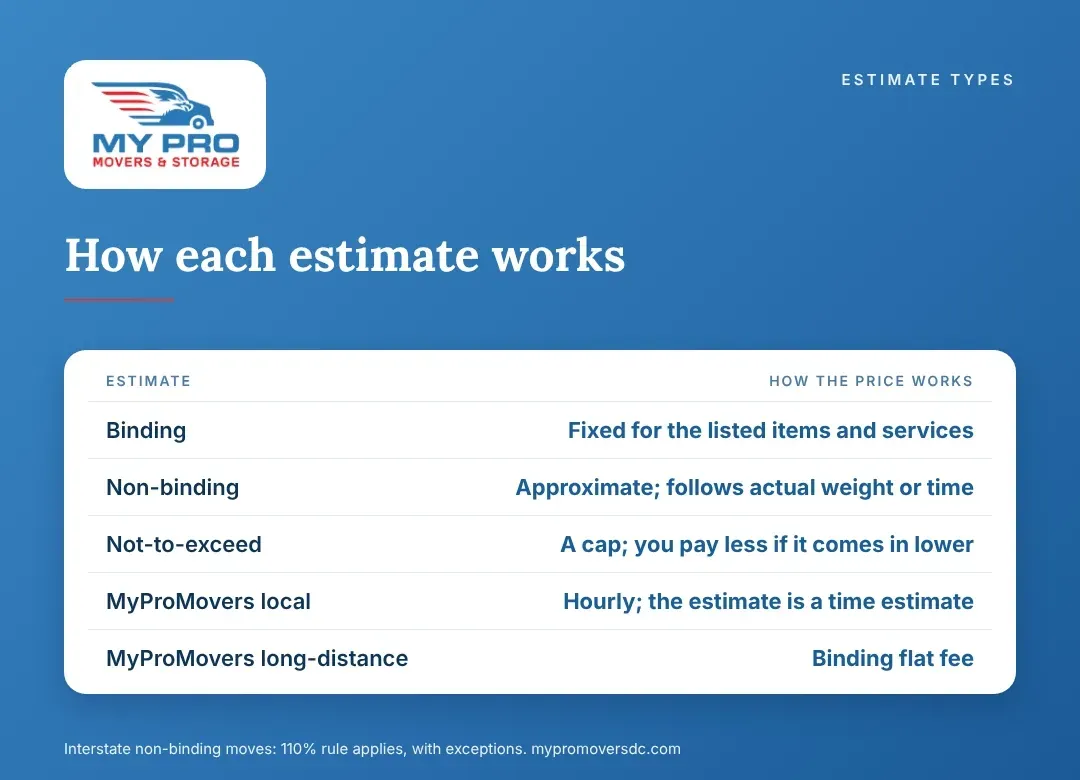
| Binding | Non-binding | Binding not-to-exceed | |
|---|---|---|---|
| What it means | A fixed price for the items and services listed | An approximation; the final cost follows actual weight or time | A maximum price; you pay less if the job comes in lower |
| If the job is bigger than expected | You pay the estimate, unless you add items or services | You pay more (interstate: at most 110% can be required at delivery, rest billed later) | You pay the cap, unless you add items or services |
| If the job is smaller than expected | You still pay the estimate | You pay less | You pay less |
| Price certainty | High | Low | High |
| Watch out for | Added items or changed scope change the price | Very low numbers that grow | Not every mover offers it |
Sources: FMCSA, Protect Your Move (Estimating Charges); 49 CFR 375.401 and 375.405; This Old House (Jun 2026).
Binding estimate
A binding estimate is a written agreement made in advance that guarantees the total cost for the items and services listed. At delivery you cannot be required to pay more than the estimate, except for services you add after signing and for impracticable operations (see below). The trade-off: if you move less than planned, you generally still pay the quoted amount.
Non-binding estimate
A non-binding estimate is the mover's best calculation, not a guaranteed final price. Final charges follow the mover's tariff, based on actual weight and the services provided. It can work for small, carefully measured moves or when you are still deciding what to bring. It is also where lowball pricing hides, because the number on paper is not necessarily the number you pay.
Binding not-to-exceed estimate
A binding not-to-exceed estimate sets a maximum price: if the job comes in bigger you pay the cap, and if it is smaller you pay less. FMCSA's consumer pages do not describe it as a separate federal category, and few long-distance movers offer it (This Old House), so ask whether it is available.
How the 110% rule works on interstate moves
On an interstate household-goods move with a non-binding estimate, FMCSA rules let the mover require payment of up to 110% of the estimate at delivery for the services and quantities shown in the estimate. If the bill is higher, the mover must release your goods when you pay 110% and bill the rest later, with at least 30 days to pay (49 CFR 375.405; FMCSA).
Illustrative example: your non-binding estimate is $4,000 and the final charges for the same services come to $4,480. At delivery the mover can require $4,400 (110% of $4,000). The other $80 is billed afterward. The 110% limit is not a cap on your total bill, only on what can be required at delivery.
- The rule has exceptions:
- Binding estimates. The 110% rule is about non-binding estimates. A binding estimate holds at the quoted amount for the listed items and services.
- Services you add. Services you order after signing, or that were not in the estimate, can be collected at delivery in addition to the 110%.
- Impracticable operations. Charges for these, as defined in the mover's tariff (for example, an extra-long carry or a shuttle the truck could not avoid), can be collected at delivery up to 15% of the other charges due at delivery. Anything above that is billed later.
- Moves outside FMCSA rules. Federal rules cover interstate household-goods moves. Whether a short move across the DC, Maryland or Virginia line is covered can depend on exceptions such as commercial-zone rules, so ask the mover which rules apply and get the answer in writing.
How MyProMovers prices local and long-distance moves
Local moves are billed by the hour, so a local estimate is an estimate of time, not a fixed price. The final charge follows the time actually worked.
Every local move also has a separate service charge, and billing runs from the crew's arrival at your origin until the work is completed at the last stop, including driving between stops. Our starting rates and service charge are listed in how much movers cost in Washington, DC.
Long-distance moves get a binding flat fee. We price them from your inventory and the agreed scope. As long as you do not add items or change the scope, the price does not change. That is the point of a binding estimate: no surprise at delivery because the truck came in heavier than expected. If you add items or change the scope, we update the price before the work, in writing. A 10% deposit reserves the move, and the balance is collected when day one is completed. For local moves the deposit is usually $100, and payment is collected before unloading.
Long-distance: one binding flat fee. Based on your inventory and agreed scope. It stays the same unless you add items or change the scope.
How we estimate depends on the move: a LiveSwitch virtual walkthrough is our preferred method, and we also use photos or an on-site visit when appropriate.
Which moving estimate is best for you?
| Your situation | Best estimate type | Why |
|---|---|---|
| Fixed budget, can't afford surprises | Binding (or not-to-exceed, where offered) | The price does not change for the listed inventory unless you add items or change the scope |
| Long-distance move, lots of furniture | Binding | Protects you if the weight or volume was underestimated |
| Small move, every item measured | Non-binding can work | You pay only for actual weight or time |
| Still decluttering | Non-binding, then update the estimate before moving day | You'll pay less if you move less |
| Local hourly move | Written time estimate with the rate, minimum and fees | Hourly totals follow the time actually worked |
When an estimate changes
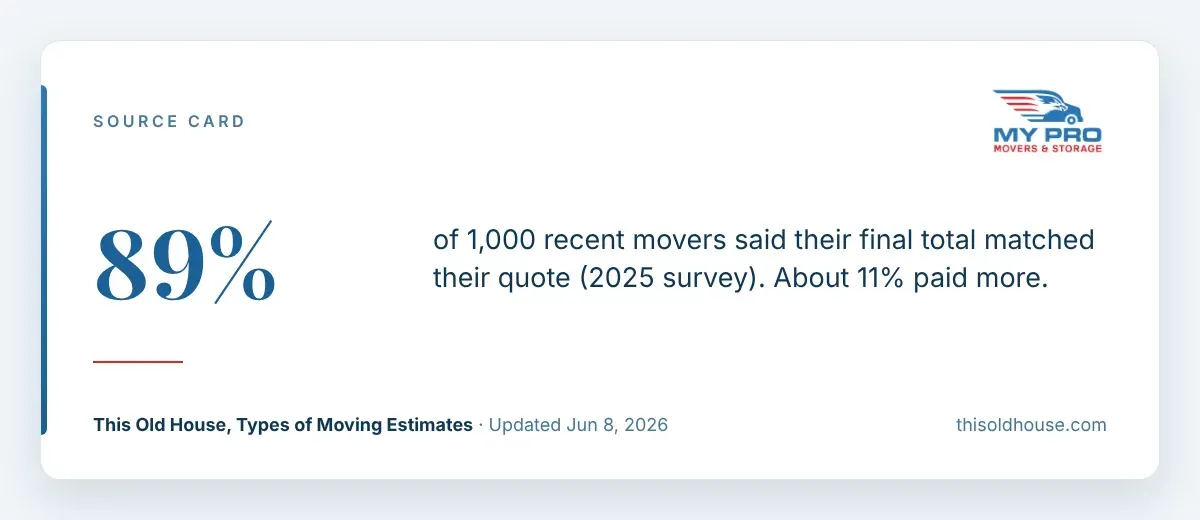
Most estimates hold. In a 2025 survey of 1,000 recent movers reported by This Old House, about 89% said their final total matched their quote; of the roughly 11% who paid more, most overages were $200 to $1,000. The usual causes: overlooked items, last-minute additions and underestimated weight.
A price change is not automatically a red flag. A legitimate change is one you agreed to: you add items, change the scope (an extra stop, more stairs, packing you asked for) or a documented service is added, and the mover explains it before doing the work. A problem is a new charge that is not in your contract, or a demand for an unexplained amount before your goods are released. Ask for any change in writing and compare it with your signed estimate. Payment timing is also a contract term: for local moves we collect payment before unloading, and that is stated up front.
Want to know how your move would be priced?. Tell us about your move and get a written estimate with every service listed. Get my free moving quote
How estimates are prepared: on-site, virtual or by photos
| Method | Accuracy | Good for |
|---|---|---|
| On-site visit | High: the mover sees everything | Larger homes, long-distance moves, specialty items |
| Virtual walkthrough (LiveSwitch) | High, if you show every room, closet and access point | Many moves; flexible scheduling |
| Photos | Medium: depends on how complete they are | Smaller moves or checking a few items |
| Phone or online form | Low: a rough range only | Early budgeting, not booking |
For interstate household-goods moves, FMCSA's consumer guidance calls for a physical survey of your goods when your home is within 50 miles of the mover's place of business, unless you waive it in writing before loading. Practices vary by mover, so ask which method applies to your move.
Example: three estimates for the same Fairfax-to-Raleigh move
This example is illustrative. A family in Fairfax gets three written estimates for a 3-bedroom move to Raleigh:
- Mover A, non-binding: $3,600. The final charges come to $4,300. At delivery the mover can require up to $3,960 (110%); the remaining $340 is billed later.
- Mover B, binding: $4,200. You pay $4,200 whether the job comes in bigger or smaller, unless you add items or change the scope.
- Mover C, not-to-exceed: $4,100. The shipment comes in lighter than estimated, so they pay $3,850. Had it been heavier, they'd still pay at most $4,100.
Mover A looked cheapest on paper and cost the most ($4,300, against $4,200 and $3,850). Compare estimate types, not just totals.
What your written estimate should include
- Estimate type: binding, non-binding or not-to-exceed, in plain words.
- Inventory of what's being moved (attached), and how it was surveyed.
- Rate basis: hourly crew rate, a binding flat fee, or weight/volume and distance.
- Every service and fee: packing, materials, stairs, long carry, shuttle , storage.
- Valuation, which is the mover's liability for your belongings, and whether you are buying separate third-party insurance.
- Pickup and delivery dates or windows.
- Deposit, payment and cancellation terms.
- The mover's legal name, USDOT and MC numbers, and signatures.
Estimate red flags
- A firm price given over the phone without any survey.
- Only non-binding estimates offered, and far below every other quote. This Old House advises caution with movers who offer only non-binding estimates and with unusually low quotes.
- Blank fields or a request to sign before the estimate is complete.
- A new charge that is not in your signed contract, or goods held until you pay an unexplained amount. Changes you requested, or documented services explained in writing, are different.
- An estimate from a company that will not do the move itself.
About MyProMovers
MyProMovers is a DC-area moving company with its own crews, serving DC, Maryland and Northern Virginia, with 40,000+ completed moves. Look us up: USDOT #3116640, MC #1001869, Virginia Intrastate For-Hire Certificate #709.
Frequently asked questions about moving estimates
What is the difference between a binding and a non-binding moving estimate?
A binding estimate fixes the price for the items and services listed, even if the job turns out bigger than expected. A non-binding estimate is an approximation; the final price follows actual weight or time. On interstate household-goods moves, a mover can require at most 110% of a non-binding estimate at delivery, with exceptions for services you add and impracticable operations.
What is a binding not-to-exceed estimate?
A binding not-to-exceed estimate sets a maximum price. If the job comes in bigger, you pay the cap; if it is smaller, you pay the lower actual cost. Not every mover offers it, so ask.
What is the 110% rule for movers?
On an interstate household-goods move with a non-binding estimate, a mover can require payment of up to 110% of the estimate at delivery for the services in the estimate, and bill the rest later. Services you add after signing and impracticable operations can be collected at delivery on top of that, and binding estimates are not subject to the rule. For example, on a $4,000 non-binding estimate, the most that can be required at delivery for the listed services is $4,400.
Which moving estimate is best?
If price certainty matters most, a binding estimate is the safest, and our long-distance moves use a binding flat fee. A non-binding estimate can make sense for a small, carefully measured move. Whatever you choose, get it in writing.
Is a local hourly moving quote binding?
Not at MyProMovers: local moves are billed by the hour, so the estimate is a time estimate and the final charge follows the time worked. Our starting rates and service charge are in our moving cost guide. Ask any mover for the rate, minimum and fees in writing.
Can movers give an estimate over the phone?
They can give a rough range, but a reliable estimate needs a closer look at your belongings: a virtual walkthrough, photos or an on-site visit, depending on the move. Treat any firm phone price with caution.
What can change a long-distance binding flat fee?
Adding items to the inventory or changing the agreed scope. Without either, the fee stays the same. The deposit is 10%, and the balance is collected when day one is completed.
The bottom line
Compare estimate types, not just totals. A binding estimate protects your budget, and a non-binding one puts more risk on you, softened on interstate moves by the 110% rule and its exceptions. Get every estimate in writing with all fees listed.
Get an estimate you can count on. Tell us about your move and we will explain how it would be priced. Get my free moving quote
Related guides
Sources
- FMCSA, Protect Your Move: "Estimating Charges (Subpart D)", page updated Feb 2, 2015.
- 49 CFR 375.401 and 375.405 (eCFR / Cornell LII).
- FMCSA, Protect Your Move: "Movers vs. Brokers", Updated Apr 27, 2026.
- This Old House, "Types of Moving Estimates" (incl. 2025 survey of 1,000 recent movers), Updated Jun 8, 2026.