12 Moving Scam Red Flags (and What to Do If Your Belongings Are Held Hostage)
Quick answer: The clearest moving scam red flags are a price quoted without anyone reviewing your inventory, a large cash or wire deposit, no USDOT number or address, blank forms, and charges that aren't in your written contract. A modest deposit or payment before unloading is normal when it is written down. If goods are withheld, document everything and contact FMCSA.
Key takeaways
- A red flag is a demand you can't verify or that isn't in writing, not a charge that is in your contract.
- Never sign blank forms, and be cautious about large deposits or cash, wire and gift-card payments.
- On an interstate move, FMCSA rules limit what a mover can require at delivery, with exceptions for services you add.
- If your belongings are withheld, stay calm, get the charges in writing, document everything and report it the same day.
Below are 12 red flags grouped by when they appear. We also separate legitimate, agreed charges from undisclosed demands, because several normal moving practices can look alarming if you haven't seen them before.
How common is moving fraud?
In its 2024 Operation Protect Your Move, FMCSA addressed 380 household goods complaints, 128 of them hostage complaints. That is a national number, but the warning signs are the same in DC, Maryland and Virginia.
What are the red flags of a moving scam?
Here are the 12 warning signs, in the order you're likely to see them. One flag isn't proof of a scam, so ask the mover to explain it. Several together, or a refusal to put answers in writing, are a reason to walk away.
Before you book: red flags 1–6
- A firm price nobody checked. A mover who names a final price after a five-minute call hasn't seen your stairs, closets or heavy items. A virtual walkthrough, photos or an on-site visit is how a reputable mover learns what you own. For interstate moves, FMCSA requires a written estimate for every shipment, and a physical survey if you live within 50 miles of the mover's place of business unless you waive it in writing. At MyProMovers, local moves are billed by the hour, so the final charge follows the actual time worked and a local estimate is an estimate of time, not a fixed total. Whichever method a mover uses, ask how the price is calculated and what happens if the job takes longer.
- No USDOT number or physical address. Interstate movers must be registered with FMCSA ( our verification guide shows how to look the number up). Search the address on a map: AARP advises that you should find a real business location, not a house or a mailbox service.
- A large deposit, or cash, wire or gift cards only. A small deposit to hold your date is normal; many movers take a flat amount on local moves or a percentage on long-distance moves. The warning sign is a big share of the total up front, a demand for cash, wire, payment apps or gift cards, or no written receipt. Those payments are almost impossible to recover.
- No clear answer on who does the work, and in whose truck. Reputable movers may use their own crews, a rental truck for a very distant move, or a partner for a heavy item such as a piano or safe. That isn't a problem by itself. The red flag is a company that won't say who will do the work, or a broker that sells your move on without naming the carrier. Ask, and check that company separately. See moving broker vs moving company.
- A price far below every other quote, with no explanation. Ask what is left out: the hourly rate, service charge, minimums, stairs or packing. A price that only works if charges are added later is a warning sign.
- Pressure to book today. "This price expires tonight" is designed to stop you from checking reviews and records. A legitimate mover will hold a quote long enough for you to compare.
In the paperwork: red flags 7–9
- Blank or incomplete forms to sign. Never sign anything with empty price, date or inventory fields, and keep a copy of everything you sign.
- No written estimate or FMCSA booklet. For interstate moves, the mover must prepare a written estimate and give you the booklet "Your Rights and Responsibilities When You Move." A verbal quote is not an official estimate.
- A pricing method nobody can explain. Hourly rates, minimums and a travel or service charge are normal when they are stated. The red flag is a mover who can't say how the price is calculated, or who prices by vague "space" or cubic feet and won't put it in writing.
On moving day: red flags 10–12
- A demand for money that isn't in your contract. Many local movers, including us, collect payment before unloading, and that is fine when the amount and timing are in the agreement you signed. The red flag is a crew that asks for more than the contract says, or won't unload until you pay a new amount nobody explained.
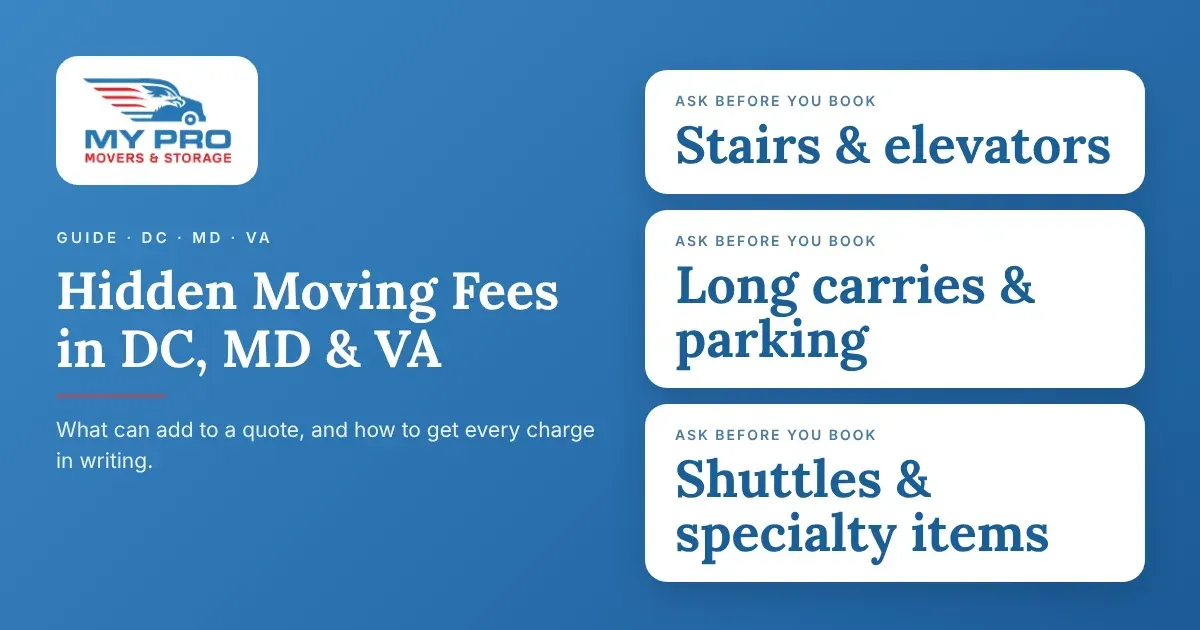
- New charges nobody can explain. A bill can legitimately go up when you add items, change the scope or the stops, or ask for extra services, and a good mover shows you what changed. The red flag is an increase that was never disclosed and can't be tied to anything you changed, such as "your stuff took more space than expected" after loading. For interstate moves, FMCSA says a mover may not change an estimate after loading (exceptions are explained below). Our guide to hidden moving fees in DC, MD and VA covers the charges you should see up front.
- No delivery date or location for your goods. On a long-distance move, get the delivery window and any storage location in writing before the truck leaves.
Moving scam red flags at a glance
| # | Red flag | Why it matters | What to do |
|---|---|---|---|
| 1 | A firm price nobody checked | A real estimate needs a look at what you own | Ask how the price was built; get a written estimate |
| 2 | No USDOT number or physical address | Interstate movers must be registered with FMCSA | Look the number up; map the address |
| 3 | A large deposit, or cash or wire only | Little recourse if the mover disappears | Ask for a card option and a receipt; a small deposit is normal |
| 4 | No clear answer on who does the work and in whose truck | Rental trucks and partners can be legitimate; secrecy is not | Ask who does the work and in whose truck; check that company |
| 5 | A price far below other quotes | Missing charges may appear later | Ask what is left out; compare like for like |
| 6 | Pressure to book today | It stops you from checking records | Take a day; a good mover will hold the quote |
| 7 | Blank or incomplete forms | Terms can be filled in later | Never sign a blank document; keep copies |
| 8 | No written estimate (interstate) | Interstate movers must provide one | Don't book until you have it in writing |
| 9 | A pricing method nobody can explain | Easy to inflate after loading | Ask for rates, minimums and travel charge in writing |
| 10 | A demand for money not in the contract | Payment before unloading is normal if agreed; new amounts are not | Compare with your contract; ask for itemized charges |
| 11 | New charges nobody can explain | Added items or changed scope can change a price; an unexplained increase is the flag | Ask what changed, in writing |
| 12 | No delivery date or location | Your belongings could be in an unknown warehouse | Get the delivery window and address in writing |
What is a hostage-load moving scam?
A hostage load is when a mover loads your belongings, then refuses to deliver them unless you pay much more than the agreed price. Not every dispute is one: FMCSA notes that an interstate mover can legally hold your belongings if you don't honor your contract and pay on time. It becomes a hostage load when the demand goes beyond what your contract and the rules allow.
The rules for interstate moves (FMCSA, 49 CFR Part 375): a mover may not change an estimate after loading. On a binding estimate, the mover must deliver your shipment when you pay the estimated amount. On a non-binding estimate, the mover must give you possession when you pay 110 percent of the estimate and bills any remaining charges 30 days after delivery. There are exceptions for services you add after signing and for impracticable operations; binding vs non-binding moving estimates explains the 110% rule and its exceptions. These are federal rules for interstate moves; for a move that stays within one state or the DC area, ask the mover which rules apply.
What to do if a mover holds your belongings hostage
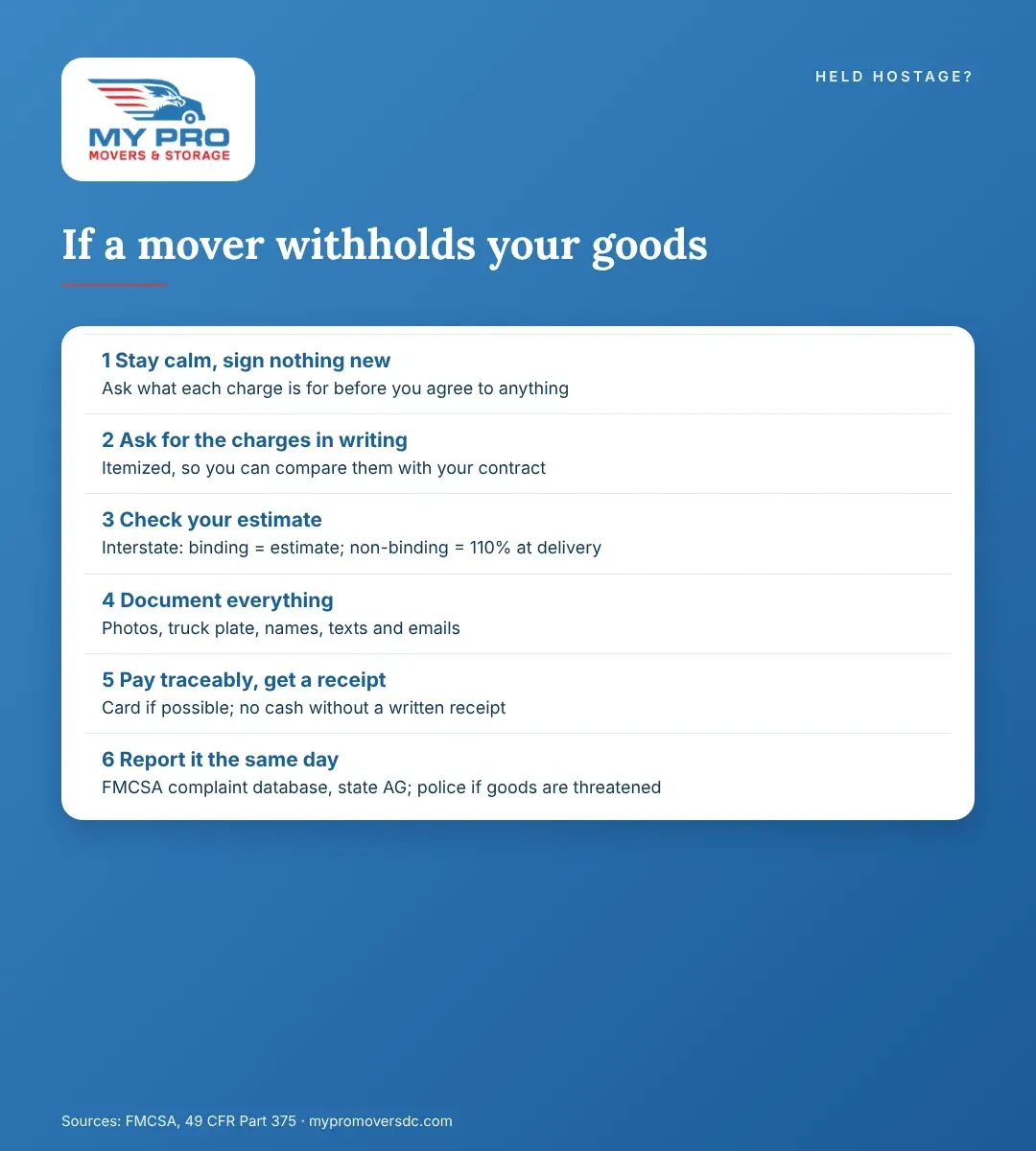
- Stay calm and don't sign anything new. Don't agree to a new price or sign a new document under pressure. Ask what each charge is for.
- Ask for the charges in writing. Request an itemized list and compare it with your contract and estimate. Services you actually added can legitimately be charged.
- Check the rules for your move. For an interstate move, compare the demand with the binding and non-binding limits above, including the exceptions.
- Document everything. Take photos of the truck, license plate, USDOT number on the door and crew names, and save every text and email.
- If you must pay to get your belongings back, pay traceably. Use a credit card if possible, get an itemized written receipt, never pay cash without one, and keep records so you can dispute the charge or complain afterward. FMCSA doesn't settle individual disputes, but it can investigate and take enforcement action.
- Report it the same day. File a complaint in FMCSA's National Consumer Complaint Database (1-888-368-7238) and with your state attorney general. Call police if your goods are threatened with sale or you feel unsafe, and ask for a report number. For damage or loss after delivery, file a written claim with the mover; FMCSA's handbook gives interstate customers 9 months.
Want to know how your price is built?. Ask us to walk you through our hourly rates, service charge and payment terms before you book. Get my free moving quote
Example: the $1,900 quote that wasn't
This example is illustrative. A family in Silver Spring is moving a three-bedroom house to Raleigh. A company they found online quotes $1,900 over the phone without asking for an inventory, far below two other quotes of more than $5,000. It asks for a $600 deposit by payment app and emails a contract with the price field left blank "to finalize on moving day."
After loading, the crew says the shipment is "twice the size" and the new price is $6,400. Nothing was added; the inventory was never taken. That's five red flags in one move: a price nobody checked, an unrealistic quote, a payment-app deposit, a blank contract and a large increase nobody can explain.
The family that checks those flags before booking never gets to moving day with that company.
How to pay a mover safely
- Use a credit card for deposits and payments when possible. Cards offer dispute rights that cash, wires, payment apps and gift cards don't. Some movers add a card fee, which is fine when it is in the contract.
- Get the deposit amount, when the balance is due and when payment is collected in writing. Timing varies by mover; local movers often collect payment before unloading. What matters is that the contract says so.
- Get a receipt that names the company, the move date and what the payment covers.
- Pay only amounts that appear in the contract or that you agreed to in writing as an added service.
Your anti-scam checklist before booking
- I have a written estimate and I know how the price is calculated (hourly rate, minimum, travel charge or a binding flat fee).
- I looked up the USDOT number and it matches the company name and address.
- I know who will do the work (the mover's crew or a partner) and in whose truck.
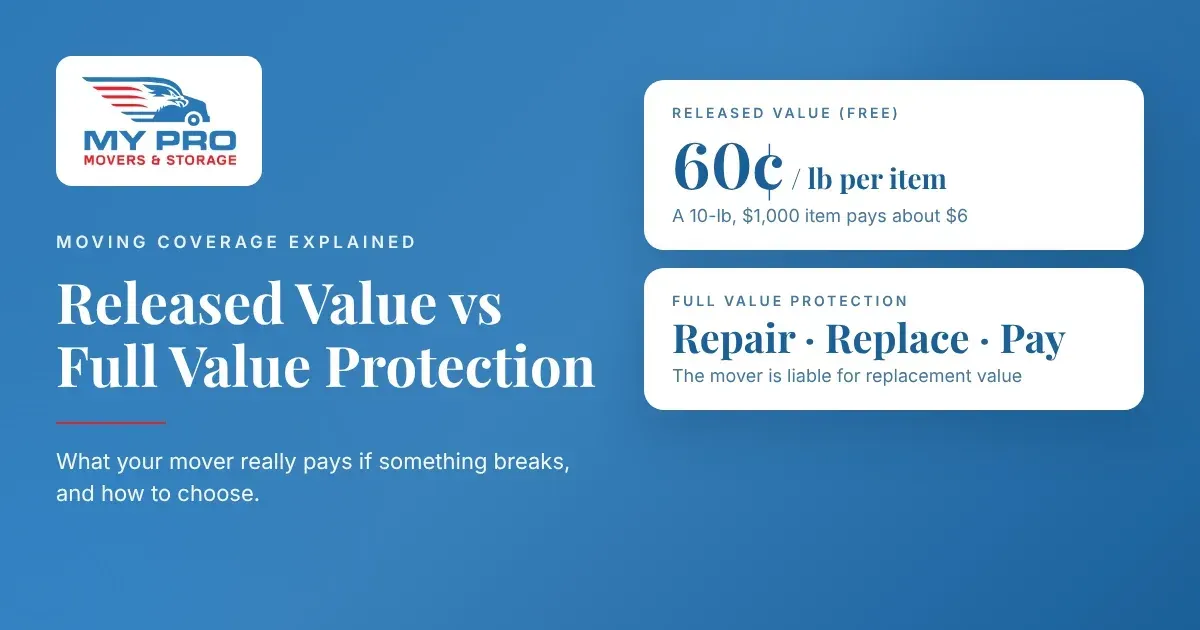
- I understand the difference between the mover's liability (valuation) and separate third-party moving insurance.
- No form I signed has blank fields, and I have copies.
- The deposit, the balance and when each is due are written in the contract.
- I've asked the mover to explain any charge I don't understand.
How MyProMovers keeps pricing honest
MyProMovers is a DC-area moving company with its own crews: USDOT #3116640, MC #1001869, Virginia Intrastate For-Hire Certificate #709. We have completed 40,000+ moves, and our deposit, payment and fee terms are written in your contract.
Frequently asked questions about moving scams
What are the red flags of a moving scam?
The main red flags are a price given without anyone reviewing your inventory, no USDOT number or physical address, a large deposit or cash-only payment, a broker that won't name the carrier, blank forms to sign, and new charges that aren't in your contract. Normal agreed charges, such as a modest deposit or payment before unloading, are not red flags. Several flags together are a strong reason to walk away.
What is a hostage load?
A hostage load is a moving scam in which a mover refuses to deliver your belongings unless you pay far more than the agreed price. On interstate moves, FMCSA rules say a mover may not change the estimate after loading and must release a shipment at 100% of a binding estimate or 110% of a non-binding one, with exceptions for services you added and impracticable operations.
What should I do if movers hold my belongings hostage?
Stay calm and don't sign anything new. Ask for the charges in writing and compare them with your contract, document the truck, plate and crew, and report the mover the same day to FMCSA's National Consumer Complaint Database and your state attorney general. Call police if your goods are threatened with sale. If you paid by credit card, ask your card issuer about a dispute.
How much deposit is normal for movers?
It varies. Local movers often take a modest flat deposit (ours is usually $100) and long-distance movers a percentage (ours is 10%). Be cautious about large upfront deposits, especially in cash, by wire, through payment apps or with gift cards. Get the amount in the contract and a receipt.
How do I report a moving scam?
For interstate movers, file a complaint in FMCSA's National Consumer Complaint Database. Also report to your state attorney general's consumer protection office and the BBB Scam Tracker. If a mover is withholding your belongings and threatening to sell them, call local police as well and keep the report number.
Should I pay movers in cash?
It's safer not to. Cash, wire transfers, payment apps and gift cards are very hard to recover if something goes wrong, while a credit card gives you dispute rights. Movers differ on which methods they accept and whether they add a card fee, so ask first. Whatever you use, get a written receipt.
The bottom line
Moving scams follow a script: a price nobody checked, pressure, a payment you can't trace, blank paperwork and a new bill nobody can explain. Normal charges are written down before moving day. If you can tell the difference, you can stop the script before it starts. Check your mover, get everything in writing and pay in a way you can trace.
Ready to compare a written quote?. Look up our USDOT number, then ask us how our rates and payment terms work. Get my free moving quote
Related guides
Sources
- FMCSA, "Your Rights and Responsibilities When You Move" (consumer handbook), Oct 2023 edition.
- FMCSA, "Estimating Charges (Subpart D)", Protect Your Move, accessed Nov 2026.
- 49 CFR Part 375, Appendix A, "Your Rights and Responsibilities When You Move" (Cornell LII), accessed Nov 2026.
- FMCSA, "Can movers hold your stuff hostage?", accessed Nov 2026.
- FMCSA, "Operation Protect Your Move: Final Report" (2024 operation), Jan 2025.
- AARP, "Moving Scams" (Fraud Resource Center), updated May 27, 2026.
- FMCSA, National Consumer Complaint Database, accessed Nov 2026.