Moving Broker vs Moving Company: What's the Difference and Why It Matters
Quick answer: A moving company (carrier) is registered with FMCSA as a mover and transports your belongings with its own trucks and staff. A moving broker sells and arranges your move but is not authorized to transport goods; it hands the job to a mover. To tell which you are dealing with, look up the company's USDOT or MC number in FMCSA's search tool.
Key takeaways
- A broker arranges your move; a moving company does it and is responsible for your goods in transit.
- Brokers must say they are brokers, give you a list of the movers they use and base estimates on the tariff of the mover that will carry the shipment.
- Before paying a deposit, get the name and USDOT number of the company that will do the move and look it up on FMCSA.
- Ask one question early: "Will your own crew do my move?"
Brokers are legal and can be useful. The risk is not knowing who will do your move until late. The sections below cover the definitions, the federal broker rules, how to check a company, and how MyProMovers works.
What is the difference between a moving broker and a moving company?
FMCSA's Movers vs. Brokers guide (updated April 2026) says a moving company owns trucks, employs moving staff and "assumes full responsibility for the transport of your goods." A moving broker does not own trucks or employ movers; it acts as an intermediary and is not authorized to transport goods.
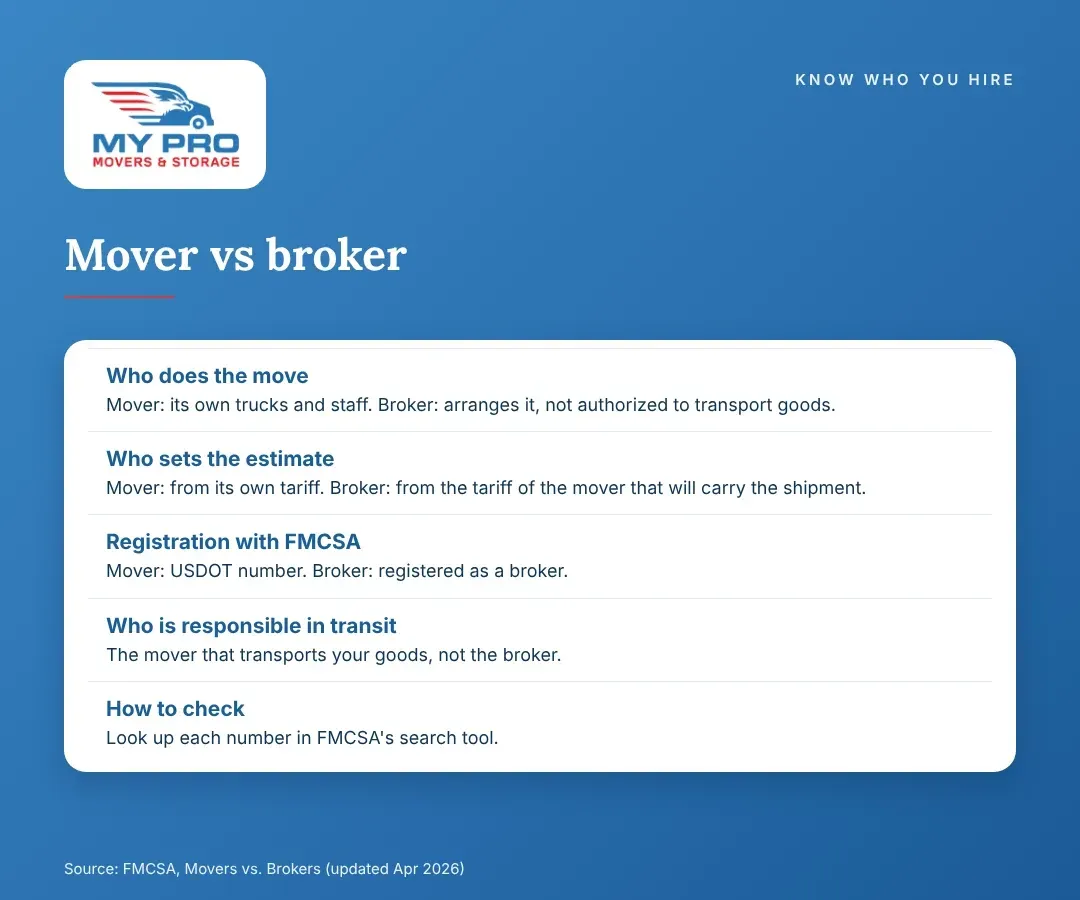
| Moving company (carrier) | Moving broker | |
|---|---|---|
| Who does the move | The mover, with its own trucks and staff | A mover the broker arranges; the broker does not transport |
| Who sets the estimate | The mover, from its own tariff | The broker, from the tariff of the mover that will carry the shipment |
| FMCSA registration | USDOT number, registered as a mover | Registered with FMCSA as a broker |
| Responsible for goods in transit | The mover | The transporting mover, not the broker; read the contract for claims |
| How to check | Look up its USDOT number in FMCSA's search tool | Look up its broker registration, then each mover on its list |
How does a moving broker work?
Most broker bookings follow a similar path:
- You request quotes online. Some comparison sites pass your details on to brokers or movers.
- A salesperson quotes a price, often over the phone.
- You may pay a deposit to reserve your date. With a broker, that money goes to the broker.
- The broker offers your job to movers it works with.
- A mover accepts and becomes responsible for the actual move, sometimes only days before moving day.
When it works, the broker finds a suitable mover at a fair price. Trouble starts when the price you were quoted differs from what a mover will accept.
Are moving brokers legal? What the federal rules say
Yes, if they are registered. Brokers arranging interstate household goods moves must register with FMCSA and follow 49 CFR Part 371, Subpart B. Whether a particular move in the DC area counts as interstate depends on the facts, so ask the company how it classifies your move. In plain language, a broker must:
| Rule | What the broker must do | What to check |
|---|---|---|
| Ads and website (371.107) | Show its physical location and MC number and state that it is a broker | Look for "broker" on the website and in the quote |
| Carriers it uses (371.105, 371.109) | Use only movers with a valid USDOT number and operating authority, and tell you which movers it uses | Ask for the list and look up each mover |
| Consumer booklets (371.111) | Provide "Your Rights and Responsibilities When You Move" and "Ready to Move?" | Get both before you sign |
| Estimates and carrier agreements (371.113, 371.115) | Base any written estimate on the tariff of the mover that will carry the shipment, under a written agreement with that mover | Ask which mover the estimate is based on |
| Deposits and refunds (371.117) | Give you its cancellation, deposit and refund policies | Read them before paying anything |
FMCSA's page adds that the mover transporting your shipment should do the physical survey of your goods, which you may waive.
Where problems can start
The price can change
A broker's quote is only as good as the mover that accepts it. If the quote was lower than what a mover will accept, the gap can show up as a higher price later. Ask whether the estimate is binding or non-binding, get it in writing, and ask which mover's tariff it is based on.
A mover may not be lined up
FMCSA's fact sheet warns that a broker may not be able to place your job with a mover, for example because the estimate was too low or movers were not available, leaving you without a mover on moving day.
You may not know who will do the move until late
With a broker, the crew that arrives may work for a company you have not heard of. Ask for the mover's name and USDOT number before you pay a deposit, look it up, and read its reviews.
Responsibility can be split
A broker does not transport your goods; the mover does. If something is damaged, your claim generally goes to the mover that transported them, which may not be a company you chose. Know the mover's name and its valuation options before moving day. Valuation (the mover's liability for your goods) is different from third-party moving insurance, which is a separate policy from an insurer.
Want a quote from a licensed moving company?. MyProMovers has its own crews. Look us up on FMCSA, then request a free estimate. Get my free moving quote
How to tell if you're talking to a broker
Brokers are required to say so in their ads and on their website, but it is easy to miss on a fast sales call. Ask:
- Are you a moving company or a broker? Do you employ the movers who will do my move?
- What is the name, USDOT number and MC number of the company that will move me?
- How will my belongings be surveyed, and by whom?
- Is my estimate in writing, and is it binding or non-binding?
- Who do I call on moving day, and who handles a damage claim?
- What are your deposit, cancellation and refund policies, in writing?
Then look up every number you are given in FMCSA's search tool, which shows registration and complaint history. A vague answer is a reason to ask again. For the full check, see how to verify a moving company; for warning signs, see our 12 moving scam red flags.
When can a moving broker make sense?
Brokers are not automatically a problem. A registered broker with a clear list of movers can help when you are moving a long way and do not know the area. If you use one:
- Look it up in FMCSA's search tool and confirm it is registered as a broker.
- Get the mover's name before paying a deposit, and verify that mover separately.
- Ask for a written estimate and which mover's tariff it is based on.
- Read the deposit and refund policy, and pay by credit card.
How MyProMovers works
MyProMovers is a moving company, not a broker. We use our own crews and normally our own trucks.
- Look us up: USDOT #3116640, MC #1001869, Virginia Intrastate For-Hire Certificate #709.
- Our own crews and normally our own trucks, for local and long-distance moves.
- Local moves are billed hourly from our starting rates; long-distance moves get a binding flat fee based on the inventory and agreed scope.
- 40,000+ moves across DC, Maryland and Northern Virginia.
For a very distant move we may rent a box truck, and occasionally a trusted partner provides extra unloading help for something heavy, such as a safe or a piano. Licensed movers can legitimately use help like this; ask any mover how it handles it.
Frequently asked questions
What is the difference between a moving broker and a moving company?
A moving company is registered with FMCSA as a mover and transports your belongings with its own trucks and staff. A moving broker arranges your move with a mover and is not authorized to transport goods. Interstate movers and brokers must each be registered with FMCSA.
What is a moving broker?
A moving broker is a company that sells and arranges household moves but does not perform them. It books your move, may collect a deposit, and arranges for a registered mover to do it. Federal rules require brokers to disclose that they are brokers, tell you which movers they use and base estimates on the mover's tariff.
Are moving brokers legal?
Yes, if they are registered with FMCSA as brokers and follow the federal broker rules: showing their location, MC number and broker status, telling you which movers they use, providing FMCSA's consumer booklets, basing any written estimate on the mover's tariff, and giving you their deposit and refund policies.
Is it better to use a moving broker or a moving company?
For most moves, hiring a licensed moving company directly means fewer parties between you and the crew. A registered broker can be reasonable, especially for a long-distance move, if you get the mover's name and verify it before paying.
How do I know if I'm talking to a broker?
Ask whether the company employs the movers and ask for the name and USDOT number of the company that will move you. Phrases like "our partner movers" or "a mover in our network" may mean a broker, but not always, so ask directly. Then check the FMCSA record.
Who is responsible for damage if I book through a broker?
The mover that transports your goods is responsible for loss or damage, not the broker. You file the claim with that mover; for interstate moves the usual deadline is nine months from delivery. Read your contract for how claims are handled, and know the mover's name and valuation options before moving day.
The bottom line
A broker arranges your move; a moving company does it. Brokers can be legitimate, but every extra party between you and the crew is another place for the price, the date or the responsibility to get unclear. Ask who will do the move, get the mover's name and numbers, and check them on FMCSA.
Request a free estimate from MyProMovers. Look up our USDOT number on FMCSA, then tell us about your move. Get my free moving quote
Related guides
Sources
- FMCSA, Protect Your Move: "Movers vs. Brokers", Updated Apr 27, 2026.
- 49 CFR Part 371, Subpart B: Brokers of Household Goods Transportation (Cornell LII), Current regulation, accessed Nov 2026.
- FMCSA, "Your Rights and Responsibilities When You Move" (consumer handbook), Oct 2023 edition (current).
- FMCSA, "Movers vs. Brokers" fact sheet (PDF), May 2023.