Hidden Moving Fees in DC, Maryland & Virginia: Stairs, Long Carry, Parking & Elevators
Quick answer: Hidden moving fees are charges that weren't clear in your quote: stairs, long carries, elevator waits, shuttle trucks, specialty items, packing materials, storage and late cancellations. Most are real costs of real work. They become a problem when they aren't explained in your written estimate or contract, so ask for every possible charge in writing before you book.
Key takeaways
- Most extra fees are legitimate. They become "hidden" when they aren't disclosed in writing upfront.
- In the DMV, access is the big driver: parking, elevators, walk-ups and long hallways.
- MyProMovers' local pricing is an hourly starting rate plus a separate service charge. Long-distance moves are a binding flat fee that changes only if you add items or change the scope.
- A new charge that isn't in your contract, especially one demanded before the mover will unload or deliver, is a red flag. A charge you agreed to is not.
Below are the charges that can show up on a DC, Maryland or Virginia move, how to spot them in a quote, and what MyProMovers charges. For overall price ranges, see How Much Do Movers Cost in Washington, DC?
What are hidden moving fees?
Most "hidden" fees are real costs of real work: carrying furniture up stairs, waiting for an elevator, or moving your things to a smaller truck when a full-size truck can't reach your street. The problem isn't the fee; it's finding out about it on moving day.
The most common extra moving fees
| Fee | When it applies | How it's usually charged | How to avoid or reduce it | At MyProMovers |
|---|---|---|---|---|
| Stairs | Walk-ups, townhouses, no elevator | Per flight, or as extra labor time | Disclose every flight at both homes | Local jobs are billed by time worked, so stairs add time; ask how your estimate treats them |
| Long carry | Truck parks far from the door | A distance-based fee, or extra time | Reserve curb space close to the entrance | Local jobs are billed by time worked |
| Elevator | High-rises, shared or slow elevators | A fee, or waiting time | Book the freight elevator for the whole move window | Waiting is part of billed time on local moves |
| Shuttle truck | A full-size truck can't reach your street | A separate fee | Ask whether a shuttle is likely at either end | Ask your estimator whether one applies |
| Heavy items | Items over 75 lbs | Per item | List heavy items upfront | $20 per item over 75 lbs; heavier items depend on the item and access |
| Parking permit | Street parking in cities | City permit cost, plus possible long carry | Apply early; post signs on time | Confirm who arranges the permit |
| Specialty items | Pianos, safes, pool tables | Quoted individually | List them when you get your estimate | Pianos generally about $195–$1,000, individually quoted |
| Packing materials | Boxes, wrap, mattress bags | By what is used | Pack non-fragile items yourself | Billed by actual usage; blankets free when collected at end of job |
| Storage | New home not ready | Monthly rate or promotion | Align closing and lease dates | See the storage note below |
| Cancel / reschedule | Changing or cancelling late | Policy-based | Read the policy before booking | Check your contract for the policy |
The last column shows MyProMovers' documented practice. Fees and rules differ between movers, so compare what each estimate lists.
Access fees: stairs, elevators and long carries
Stairs, elevators, long hallways and long carrying distances all add labor time (Bellhop). Some movers turn that into a separate fee per flight or per carry; on hourly local moves it usually appears as extra hours. Either way, tell the mover about every flight and long walk at both homes so it is reflected in your estimate.
Truck access: shuttles, parking and permits
If a full-size truck can't reach your street or building, the crew may need a smaller shuttle truck to move items. Street parking in DC may also require a permit, and without reserved curb space the truck can end up far from the door. Ask who handles permits and whether a shuttle is likely at either end.
Item fees: heavy and specialty items
Pianos, gun safes, pool tables and hot tubs need extra crew, equipment and time, so reputable movers quote them individually. Our guides to piano moving costs, gun safe moving costs and heavy appliance moving go into detail.
Service fees: packing, storage and delivery windows
Packing materials often surprise people who expected boxes to be included, so ask what is free and what is billed by usage. If your new home isn't ready, ask what storage costs and how long any promotion lasts.
Time and travel: minimums, drive time and cancellations
Local movers commonly set a minimum number of hours and may charge for travel between their warehouse and your home. Ask how the minimum and travel are billed, and read the cancellation and rescheduling policy before you book.
DC, Maryland and Virginia: local fee traps
- DC street parking. In much of DC, reserving curb space for a moving truck means getting a public-space permit and posting no-parking signs in advance. Without them, the truck may park far away (long carry) or circle the block (billable time). Apply early and confirm who handles it: you or the mover.
- High-rise rules. Buildings in DC, Arlington, Bethesda and Silver Spring often require a freight elevator reservation, a certificate of insurance (COI) from your mover and moves within set hours. Missing the window can mean waiting time or a second trip.
- Condo and apartment move-in rules. Many buildings charge move-in fees or deposits, or require elevator padding. Ask your property manager.
- Rowhouses and walk-ups. Narrow stairs, tight turns and basement units add time. Disclose every flight when you get your estimate.
- Beltway time. Rush hour on I-495, I-66 or I-395 can add drive time. Ask how travel time is charged and schedule outside peak traffic where possible.
- State lines. Whether a short move across the DC, Maryland or Virginia line is treated as an interstate household-goods move under FMCSA rules can depend on the details of the move. Ask your mover which rules apply to yours.
Want every fee explained before you book?. Tell us about both homes and we'll explain the starting rate, service charge and any extras that apply to your move. Get my free moving quote
Agreed charge or undisclosed demand?
| Situation | Agreed charge if… | Undisclosed demand if… |
|---|---|---|
| Stair or elevator charge | It's in the written estimate or contract, or comes from a change you asked for | A new charge appears for conditions you disclosed, with no explanation |
| Long carry or shuttle | The estimate or contract explains when it applies | It is "discovered" after loading with no earlier mention |
| Packing materials | Prices per item are listed and billed by actual usage | "Materials" is a vague lump sum on the invoice |
| Payment timing | Your contract states when payment is due (for example, our local payment is collected before unloading) | The mover won't unload or deliver until you pay an amount that isn't in your contract |
| Deposit | Small, documented, with a receipt and a stated payment method | Large, cash or wire only, with no paperwork |
Not every price change is a problem. A change is legitimate when you added items or services, or when the charge was in your contract. Local hourly moves are billed by time worked, so the final total can differ from the estimate. A problem is a new, unexplained amount that isn't in your contract, especially if the mover won't unload or deliver until you pay it. On interstate household-goods moves with a non-binding estimate, federal rules limit what a mover can require at delivery, with exceptions; binding vs non-binding moving estimates explains the 110% rule.
Example: how a local invoice adds up
Illustration only, not a quote. Say three movers at the $179 starting rate, 5 billed hours, and a service charge equal to the hourly rate (it can be higher, depending on round-trip travel).
- Labor: 5 hours × $179 = $895. Billing runs from arrival at the origin until work is completed at the last stop, including driving between stops.
- Service charge: $179 in this example.
- Subtotal: $1,074, before extras such as heavy items ($20 each over 75 lbs) or packing materials used.
- Paying by card adds a 5% fee, about $54 on this subtotal.
Weekend or holiday dates, extra travel miles and extra time all change the total, which is why a local estimate is hourly-based rather than a fixed price.
12 questions to ask before you sign
- How was this estimate prepared, and is it hourly-based or a fixed price?
- Are stairs, elevators and long carries included, or charged separately?
- What happens if the truck can't park close to the door?
- Will I need a shuttle truck at either end?
- Who arranges the parking permit and no-parking signs?
- Do you have a COI for my building, and can you work within its move hours?
- Which items count as specialty or heavy items, and what do they cost?
- Are blankets, wrap and mattress bags included? What do boxes cost?
- Is there a minimum, and how is travel time billed?
- What valuation or liability coverage is included, and is third-party moving insurance available?
- What are your deposit, cancellation and rescheduling policies?
- Will every charge above be on my written estimate?
How MyProMovers prices extras
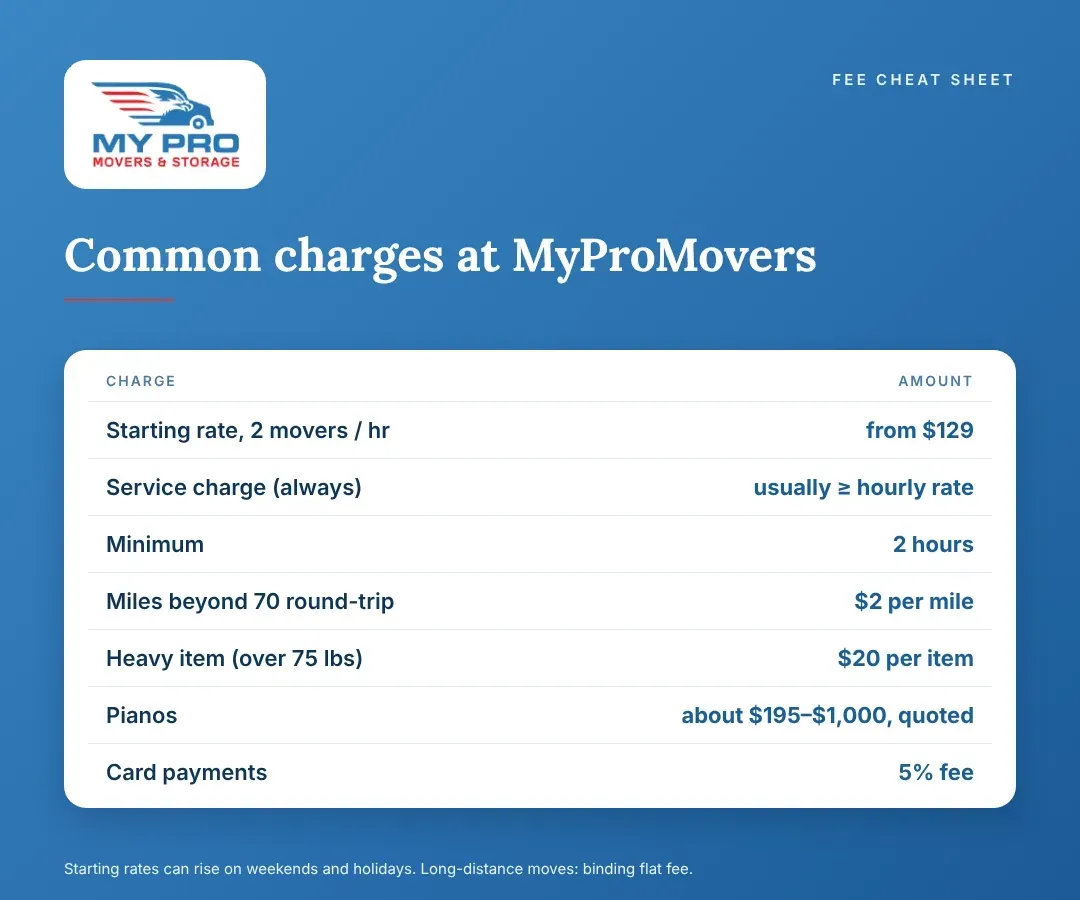
Your written estimate lists what applies to your move. Hourly rates, the service charge, deposits and payment terms are in how much movers cost in Washington, DC. Card payments carry a 5% fee, and we don't accept American Express, personal checks or money orders. Our documented extra charges:
| Item | Charge | What to know |
|---|---|---|
| Packing materials | By actual usage | Moving blankets free when collected at the end of the job; dollies, hand trucks, speedbins and tools included. Boxes: $5 small, $6 medium, $7 large, $10 dish pack. |
| Heavy items | $20 per item over 75 lbs | For heavier items the fee depends on the item and access. |
| Disposal | $45 small item, $75 large item | Ask us about larger disposal needs. |
| Pianos and specialty items | Pianos generally about $195–$1,000 | Individual quote for each, based on type, size, weight, stairs, tight turns and access. |
| QuickLift | $150 | One item, or up to two items two movers can comfortably handle; bringing items inside is included. 20 round-trip miles included, then $2 per mile (30 miles = $170). |
| Certificate of insurance | Sending ours and changing the certificate holder: free. Each additional insured: $150 | Tell us if your building requires a COI. |
Long-distance moves get a binding flat fee that changes only if you add items or change the scope. Binding vs non-binding moving estimates explains how that compares with other estimate types.
- Furniture protection and storage. In public storage, shrink wrap is $15 per item or blankets are $35 each, with a $10 refund per blanket returned in good condition; leaving furniture unprotected is possible but we don't recommend it. Our own storage is secure, has no customer access and includes free blanket use. We often run two-month-free storage promotions, and eligible Signature Realtor Club arrangements can include three or more months free; promotions depend on the offer and eligibility.
- Crews and trucks. We use our own crews and normally our own trucks, and may rent a box truck for a very distant move. For something heavy, such as a safe or a piano, a trusted partner may occasionally help with unloading.
- About MyProMovers. 40,000+ moves across DC, Maryland and Northern Virginia. USDOT #3116640, MC #1001869, Virginia Intrastate For-Hire Certificate #709.
Frequently asked questions about hidden moving fees
What are hidden moving fees?
Hidden moving fees are charges that weren't clear when you booked, such as stairs, long carries, elevator waits, shuttle trucks, specialty items, packing materials, storage and cancellation fees. Most are legitimate costs of extra work. They become a problem when they aren't disclosed in a written estimate or contract before moving day.
Do movers charge extra for stairs?
Practices vary. Some movers charge per flight, while others bill the extra labor time on hourly moves. Tell the mover about every flight at both homes when you get your estimate, and ask how stairs are handled in writing.
What is a long-carry fee?
A long-carry fee applies when movers must carry your belongings farther than a set distance between the truck and your door. The distance and price vary by mover. Reserving curb space close to the entrance is the easiest way to avoid it.
What is a shuttle fee?
A shuttle fee applies when a full-size moving truck can't reach your home, for example on a narrow street, so the crew uses a smaller truck to transfer items. Ask your mover whether a shuttle is likely at either end.
Do I need a parking permit for a moving truck in DC?
Often, yes. In much of DC, reserving curb space for a moving truck requires a public-space permit and no-parking signs posted in advance. Rules and lead times vary by street and change over time, so check DDOT's current requirements early and agree with your mover on who handles the permit.
Can a mover add fees after loading?
A mover can add charges that you agreed to or that were in your contract, such as services you added. A sudden demand for a new amount that isn't in your contract, especially one made before the mover will deliver, is a red flag: ask for it in writing, don't sign new terms under pressure, and contact the mover's regulator if needed. On interstate moves with a non-binding estimate, the 110% rule limits what can be collected at delivery, with exceptions covered in our guide to binding vs non-binding moving estimates.
How does MyProMovers calculate a local move?
Local moves are billed at an hourly starting rate for your crew size, with a two-hour minimum, plus a separate service charge. Billing starts when the crew arrives at the origin and stops when work is completed at the last stop, and driving between stops is billed hourly. Weekends, holidays and other peak dates can raise the starting rate.
The bottom line
Stairs, long carries, elevators, shuttles, permits and packing are real costs, and in the DC area they're common. The difference between a fair price and a nasty surprise is whether they're explained in writing before moving day. Ask the 12 questions, plan parking and elevators, and compare itemized quotes. For the wider price picture, see how much movers cost in DC.
Get an itemized local estimate. Tell us about both homes and we'll explain the starting rate, service charge and any extras that apply. Get my free moving quote
Related guides
Sources
- Bellhop, "2026 Local Moving Cost Guide", Jul 27, 2026.
- AARP, "Moving Scams" (Fraud Resource Center), Updated May 27, 2026.
- eCFR, 49 CFR 375.401, Binding and non-binding estimates.
- eCFR, 49 CFR 375.405, Written estimates of charges (non-binding estimates and the 110% rule).